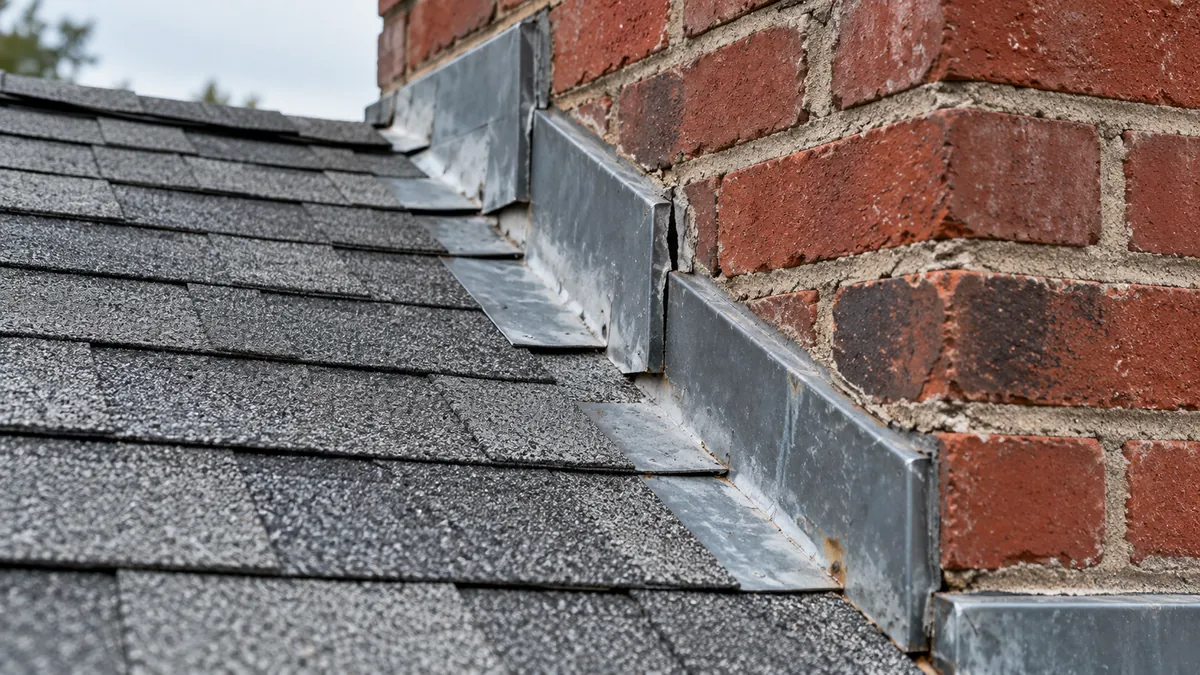
A roof leak near a chimney, wall, or vent may involve flashing, a damaged seal, nearby shingles, or the assembly around the opening. Replacing shingles alone will not fix every problem at these transitions. The repair needs to address how water enters.
Our roofing professionals at J. Bos Inc. Roofing Services investigate the leak location and explain the work needed. We distinguish a surface patch from a repair that rebuilds the affected transition.
Why roof openings and walls need special attention
Where a roof meets a vertical wall or an opening, shingles must work with flashing and surrounding materials to shed water. A gap, displaced component, deterioration, or incorrect overlap may let water enter even when nearby shingles appear intact.
For the basic definitions and locations, read our roof flashing guide. This article focuses on investigating an active leak and choosing an appropriate repair.
Leaks around a chimney
Chimney leaks deserve a closer look at the roof-to-chimney transition and the chimney itself. Flashing, surrounding shingles, masonry, and the upper chimney components may all be relevant. A stain near the chimney does not establish that one particular part failed.
Our crew will explain visible roofing concerns and whether the findings suggest another trade needs to evaluate the masonry or chimney. A roofing patch should not be presented as a complete solution to an unrelated chimney defect.
Leaks where a roof meets a wall
Wall intersections depend on coordinated roofing, flashing, and wall materials. Water may enter where those components are damaged or no longer work together correctly.
Proper access may require removing some shingles or working around siding. Ask whether the proposed repair rebuilds the transition or only adds sealant to its surface. The difference affects both the scope and the limitations of the work.
Leaks around a roof vent or plumbing pipe
Roof penetrations have their own flashing assemblies. Seals and components may deteriorate or be damaged even when the rest of the roof remains serviceable. Our inspection considers the opening and the neighboring roof area.
Some vent leaks have a localized solution. Others reveal a wider roofing problem or concealed water damage. We will explain which visible findings support the recommendation instead of assuming every penetration needs the same repair.
Why another layer of caulk may not stop the leak
Sealants have a role in roofing, but applying more material over an unidentified problem may hide its source without correcting the assembly. A previous patch that keeps reopening deserves investigation.
Tell us what was applied, when the work occurred, and whether the leak changed afterward. Photos and prior invoices help our professionals understand the repair history. Avoid disturbing the area yourself before the inspection.
What to tell us when scheduling
Explain where the stain appears, whether it changes during wind-driven rain, and whether the leak began after a storm or gradually. Water may travel before showing indoors, so the ceiling location is a clue rather than a confirmed roof entry point.
Our article on where roof leaks start explains other areas that may need checking. Stay off wet or damaged roofing and keep people clear of sagging ceilings or water near electrical equipment.
What a flashing repair estimate should explain
The estimate should identify the transition involved, which surrounding materials will be removed, and what will be repaired or replaced. Ask how concealed decking damage will be documented and approved, and whether interior restoration is excluded.
A localized flashing repair does not require replacing the whole roof in every case. Our roof inspection and repair services evaluate the surrounding roof before recommending a scope.
Schedule a cost-free roof evaluation with J. Bos Inc. Roofing Services. Mention any active dripping so we will understand the urgency of the leak.